ARTIKULO BLG. 146 | Pagbabaon ng Debris at Pagsuot ng Nakasasakit: Bakit Maililigtas ng Isang Malambot na Roller ang Iyong Aluminum Track
ARTICLE NO.146 | Debris Embedment and Abrasive Wear: Why a Soft Roller Can Save Your Aluminum Track
The sliding door roller and its track form one of the most vulnerable wear pairs in any building. Day after day, the roller carries the full weight of a heavy glass or timber panel along an aluminium track, while dust, sand, and airborne particles settle onto the running surface. The conventional intuition—that a harder roller resists wear better—turns out to be precisely wrong in this application. A roller that is too hard does not wear itself; instead, it grinds debris into the track, transforming harmless particles into embedded abrasives that progressively destroy the aluminium running surface. Understanding the tribology of debris embedment reveals why a softer roller can extend the life of the entire sliding system.
The Problem of Third-Body Abrasion
In an ideal sliding door system, the roller and the track would contact each other directly, with only a thin lubricant film between them. Real-world conditions are far messier. Airborne dust, sand grains carried in on shoes, construction debris from nearby work, and even dried leaves and insect fragments find their way onto the track surface. When the roller passes over these particles, one of two things happens. If the roller material is soft enough relative to the particle, the particle embeds into the roller surface, becoming trapped harmlessly within the polymer or elastomer. If the roller is too hard, the particle cannot embed and instead is pressed into the track surface, scratching and gouging the aluminium with each passage. This is the fundamental mechanism of third-body abrasion—the debris becomes the cutting tool, and the track becomes the workpiece. The damage is cumulative and irreversible. Each scratch creates a new stress concentration and a new site for corrosion to begin.
Hardness Mismatch and Track Destruction
Aluminium is a fundamentally soft structural metal. Even the hardened alloys used in architectural extrusions—typically 6063-T5 or 6061-T6—have a Brinell hardness in the range of 60 to 95. Common airborne abrasive particles, particularly silica sand, have a hardness of approximately 800 to 1000 on the Knoop scale, making them far harder than the aluminium track. A steel roller, with a hardness of 200 to 400 Brinell, is also much harder than the aluminium but still softer than the silica particles. When a steel roller encounters sand on an aluminium track, the particle cannot embed in the steel. It becomes trapped between two hard surfaces—the roller above and the track below. The roller's weight and the sliding motion drive the particle into the aluminium, creating a ploughing action that cuts a groove along the track. Over thousands of door cycles, these microscopic grooves accumulate into visible scoring, then into deep channels that interfere with smooth rolling. The steel roller remains relatively undamaged while the track is progressively destroyed.
The Soft Roller Solution
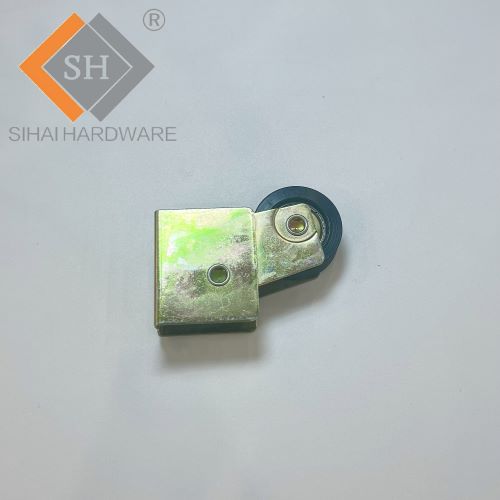
A roller manufactured from an engineering polymer—typically polyamide, acetal, polyurethane, or thermoplastic elastomer—offers a fundamentally different interaction with debris. These materials have hardness values typically in the range of 60 to 95 Shore D, which is orders of magnitude softer than silica sand. When such a roller encounters a hard particle on the track, the particle presses into the roller surface rather than into the aluminium. The polymer deforms elastically or plastically around the particle, capturing it within the roller tread. This embedment removes the particle from the rolling interface, preventing it from acting as a cutting tool against the track. The roller becomes a sacrificial debris trap, accumulating particles within its surface layer while protecting the track underneath. The process is not without consequence—the embedded particles eventually increase the roller's effective surface roughness and can accelerate wear of the roller itself—but the trade-off is highly favourable. Replacing a worn polymer roller every few years is inexpensive and straightforward. Replacing a scored aluminium track is a major building repair involving frame disassembly, finish restoration, and significant labour cost.
Material Selection for Optimal Embedment
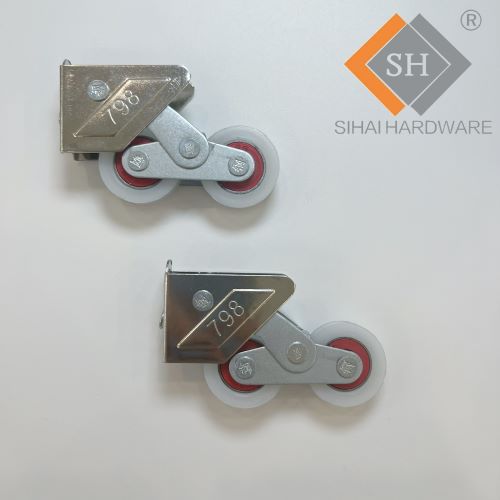
Not all soft rollers are equally effective at debris embedment. The roller material must balance several competing requirements: sufficient hardness to carry the door weight without excessive deformation, enough softness to allow particle embedment, adequate toughness to resist tearing when particles are pressed into the surface, and low rolling resistance for smooth door operation. Polyamide rollers offer a good balance for moderate-weight doors, with sufficient load capacity and acceptable embedment behaviour. Polyurethane rollers provide higher load capacity and excellent elastic recovery, allowing them to deform around particles and then spring back, ejecting debris over time. For heavy commercial doors, thermoplastic elastomer rollers combine the load-bearing characteristics of harder polymers with the compliance needed for effective debris management. Some premium roller designs incorporate a composite structure: a harder core for structural integrity and a softer tread layer specifically engineered for particle embedment. This layered approach allows independent optimisation of load capacity and debris behaviour.
Track Protection in Coastal and Arid Environments
The debris embedment mechanism becomes critically important in two environments where sliding door roller systems face extreme conditions. In coastal installations, the airborne debris includes not only silica sand but also salt crystals, which are both abrasive and corrosive. Salt particles embedded in a polymer roller are isolated from the aluminium track by the roller material itself, reducing the galvanic and chemical corrosion that would occur if the same particles were ground into the track surface. In arid and desert environments, fine airborne dust is a constant presence. This dust, composed largely of quartz particles, settles continuously on tracks. A hard roller in these conditions effectively functions as a grinding wheel, lapping the track surface with each passage. A soft roller absorbs the dust particles into its tread, and while the roller will require more frequent replacement than in cleaner environments, the track remains serviceable for the life of the door. The alternative—a scored track requiring replacement—is far more disruptive and expensive.
Balancing Wear Rates in a Sliding System
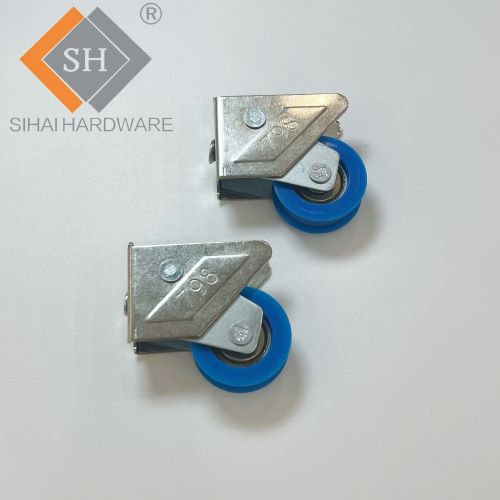
From a system design perspective, the roller and track should be treated as a wear pair in which one component is deliberately designed as the sacrificial element. In automotive engineering, brake pads are softer than brake discs because pads are easily replaced and discs are not. The same principle applies to sliding door hardware. The roller is accessible, relatively inexpensive, and can be replaced in minutes by a single maintenance technician. The track is integral to the door frame, expensive to access, and costly to replace. Designing the roller as the softer, sacrificial component—accepting that it will wear and require periodic replacement—protects the track over the long term. This design philosophy is entirely consistent with lifecycle cost optimisation. A building owner who replaces polymer rollers every five to eight years will spend far less over a thirty-year building life than one who installs steel rollers and must replace scored aluminium tracks after fifteen or twenty years.
Conclusion
The intuition that harder materials resist wear better fails in the presence of third-body abrasives. A sliding door roller made from an engineering polymer, softer than the debris particles it encounters, protects the aluminium track by allowing those particles to embed harmlessly into its own surface rather than plough through the track. This sacrificial behaviour transforms the roller from a simple load-bearing wheel into an active debris management device. The track remains smooth, the door continues to slide quietly, and the only maintenance cost is periodic roller replacement—a task measured in minutes and tens of dollars rather than days and thousands. In the tribological environment of a sliding door, the soft roller is not the weak link. It is the component that preserves the rest of the system.